




Our correspondent is on the curling scene in Halifax with scoops on stones, cowbells, LSD (it’s not what you think) and being a fire hazard
HALIFAX – Are we having fun yet?
It’s the ninth Canadian Curling Trials from the Scotiabank Centre. It’s Monday: the opening weekend has concluded, teams are debriefing with coaches, watching game films and formulating plans for the first weekday pressure cooker.
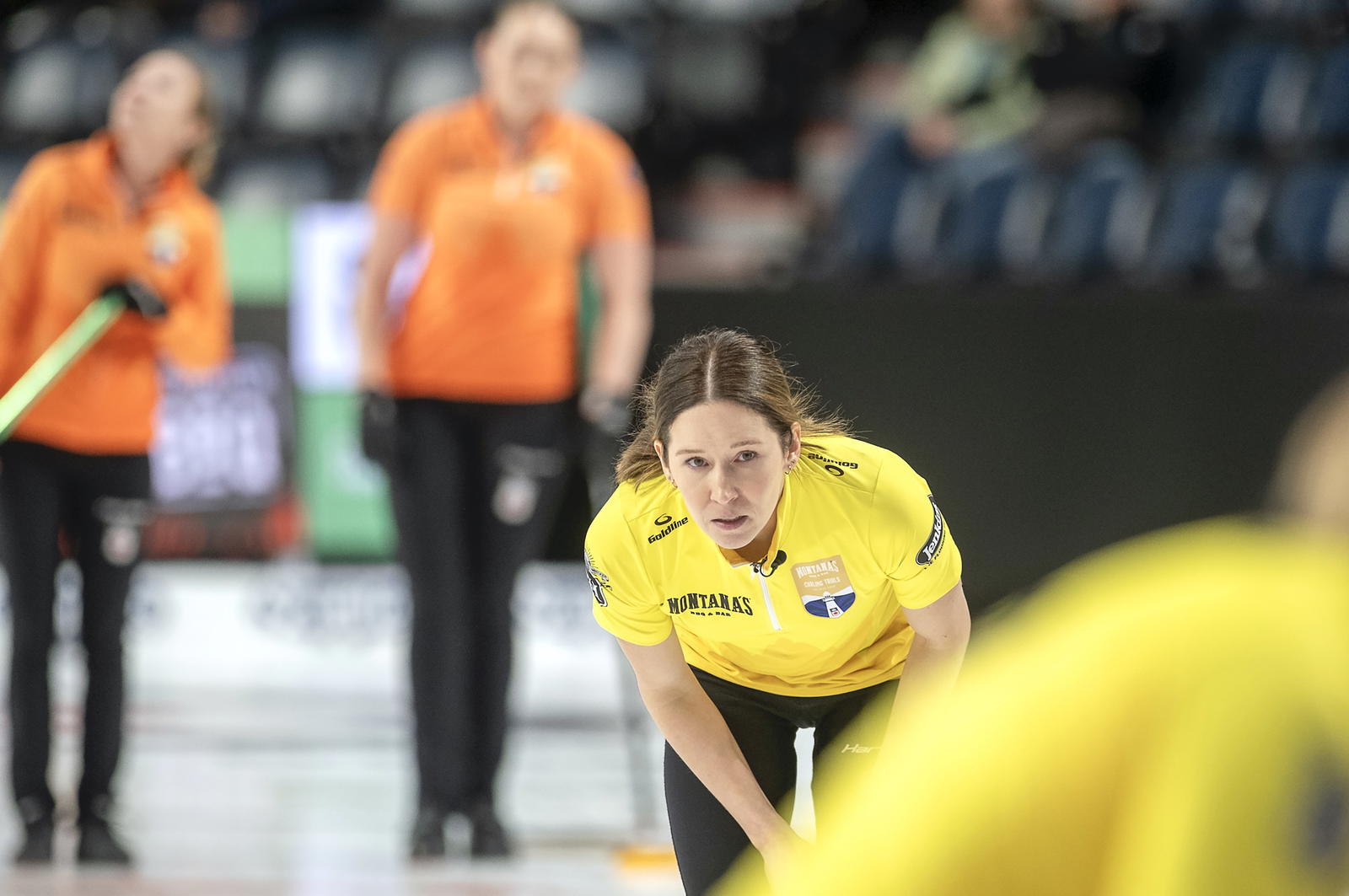 Andrew Klaver-Curling Canada
This event challenges teams from their opening stone. With only seven games to play against the best teams in Canada, every miss is amplified and there is no room for errors. Nerves became apparent as the first hour of the event featured steals of one point (twice), two (twice), three and four.
Conditions on Saturday were challenged by a hobbled dehumidifier. All but one of the favourites were able to adjust and earn a victory, but Kevin Koe stole a win over Brad Jacobs in an extra end. Jacobs third Marc Kennedy appeared frustrated and hoofed a stone into the corner so quickly that some in the stands were uncertain who won.
This building has had challenges with ice in the past, most notably at the 1995 Brier, but ice technology and technicians have improved in 30 years. Overnight efforts brought the equipment back online and Sunday’s play was less “frosty.”
Curling stones might be an adjustment for teams this week. These are Scotland Kays, the same type used at the Olympics and world championships, rather than stones commonly seen at a Grand Slam or past Briers and Scotties. They are taller, flatter and appear larger, though it could be an optical illusion?
 The new “fat” stones at right • TSN
There is no specific size for stones required, just a guide for not to exceed dimensions in rule R2 (a).
“A curling stone is of circular shape, having a circumference no greater than 914 mm. (36 in.), a height no less than 114 mm. (4.5 in.) and a weight, including handle and bolt, no greater than 19.96 kg. (44 lbs.) and no less than 17.24 kg. (38 lbs.).”
It’s uncertain if there is any noticeable difference in the dreaded striking band. There is some speculation that the Kays stones are better at absorbing water and handling frost.
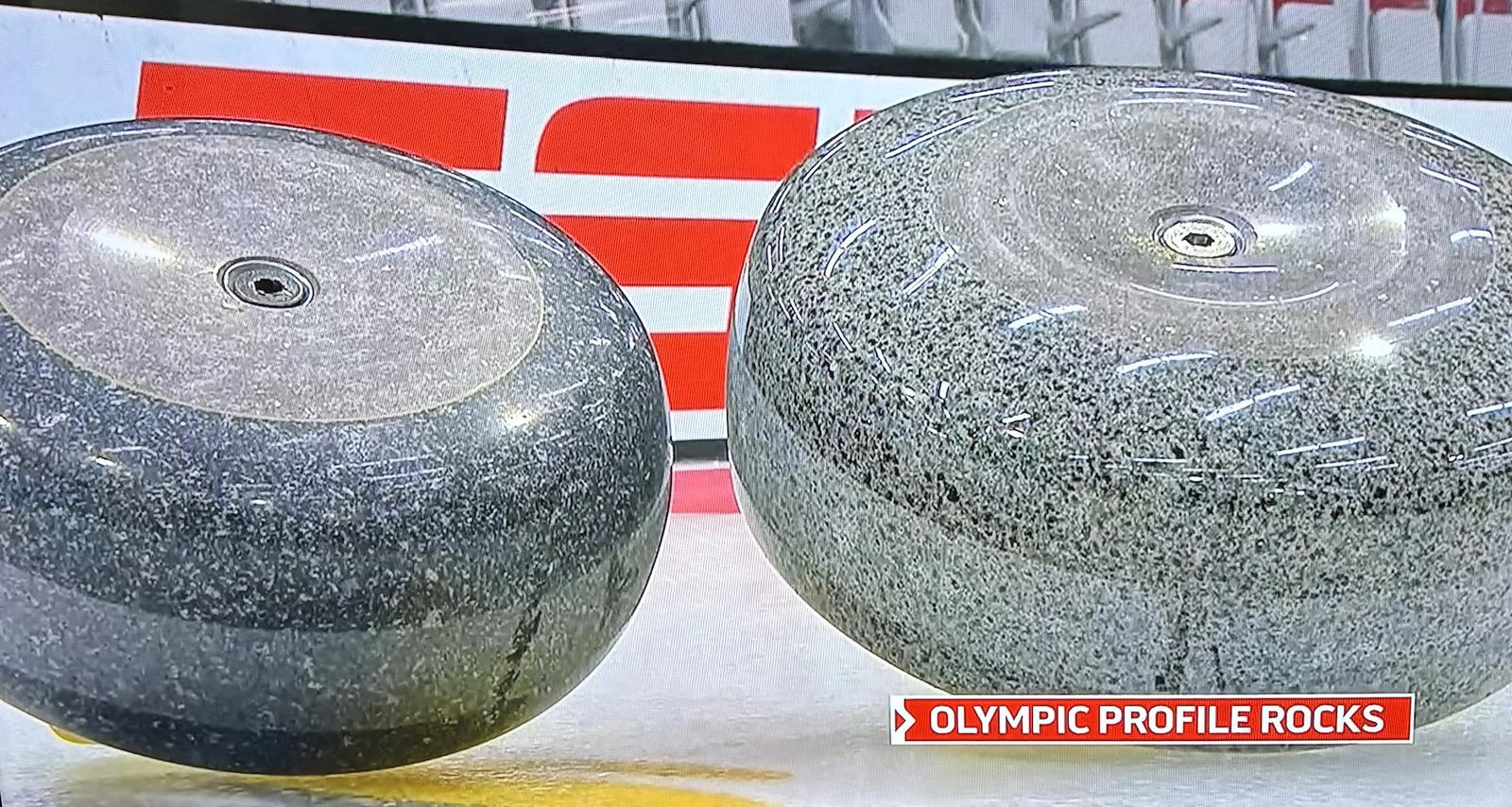 “Fat” running surface at right • TSN
There are no tiebreakers this week. With only seven games and a packed field of talent, adapting to uncertain conditions becomes even more crucial.
Consider that a team, perhaps the one that Canada has its fingers crossed to represent in Cortina, could stumble early in poor conditions, rally to finish 5-2 but miss the playoffs due to a losing Last Stone Draw (LSD).
I spoke to several in Curling Canada, including David Murdoch, and the reasons for this approach are varied. Tiebreakers are not a simple matter to arrange and there are some challenges with logistics. The worlds and Olympics use the same rule to resolve ties, and the Canadian championships have already followed suit to align with this approach.
The counter argument is the Canadian Trials don’t need to perfectly match the Olympics in an event created to send the best representative. Some nations simply tap someone on the shoulder to go rather than marching them through a gruelling competition, and in that case LSD is unnecessary.
David reminded me of Beijing 2022, where Canada’s Jennifer Jones missed out on a playoff spot due to poor LSD, while Scotland’s Eve Muirhead, with an identical 5-4 record, won gold. The theory is by converting Canadian championships to the use of LSD rather than tiebreaker games, teams will put greater emphasis on the skill and subsequently be more prepared at world competitions.
When you consider these points, it seems to make sense, but still feels odd that such a minor, non-strategic part of the sport – which takes place separately from your opponent, prior to the actual game – can have an oversized influence on the outcome of a competition. On my other shoulder, the talking devil (or is it the angel?) whispers… “it doesn’t matter, just win your games.”
 CAN crushed by LSD in Beijing • CBC Olympics
Expectation was that Rachel Homan would win all her games. She did not. Kayla Skrlik defeated Homan in an extra end on Sunday night, the first Canadian skip to do so since Kerri Einarson on October 6, 2024.
There were many on social media clamouring for a Homan crowning rather than subjecting to a Trial(s). The sentiment is that Rachel and team haven’t lost in ages so we should send them to represent Canada and ensure a gold medal.
This thinking is less than ideal for several reasons. For one, it’s sports, which is a diversion from real life. Entertainment, not life and death. Don’t we want more dramatic, meaningful games to watch and enjoy?
David Murdoch pointed out another reason. One of Canada’s strengths is the pool of talent and the value in having goals for developing teams. By sending Team Homan to Italy without a competition, the other 35 players and respective coaches lose an opportunity to improve, to test themselves against the highest pressure-packed moments which could, at worst, even discourage them from continuing in the sport. The short term gain of improving percentages in winning a gold medal is outweighed by the long term advantage of a large pool of curlers who may reach elite status.
Murdoch mentioned the European championship currently underway in Finland and though it offers a similar level of competition, many in Europe would desire to have an event like the Canadian Olympic Trials to test their mettle.
I’m not certain why anyone would choose to feel like the pit of their stomach is filled with a family of rabid squirrels, but athletes are a strange bunch.
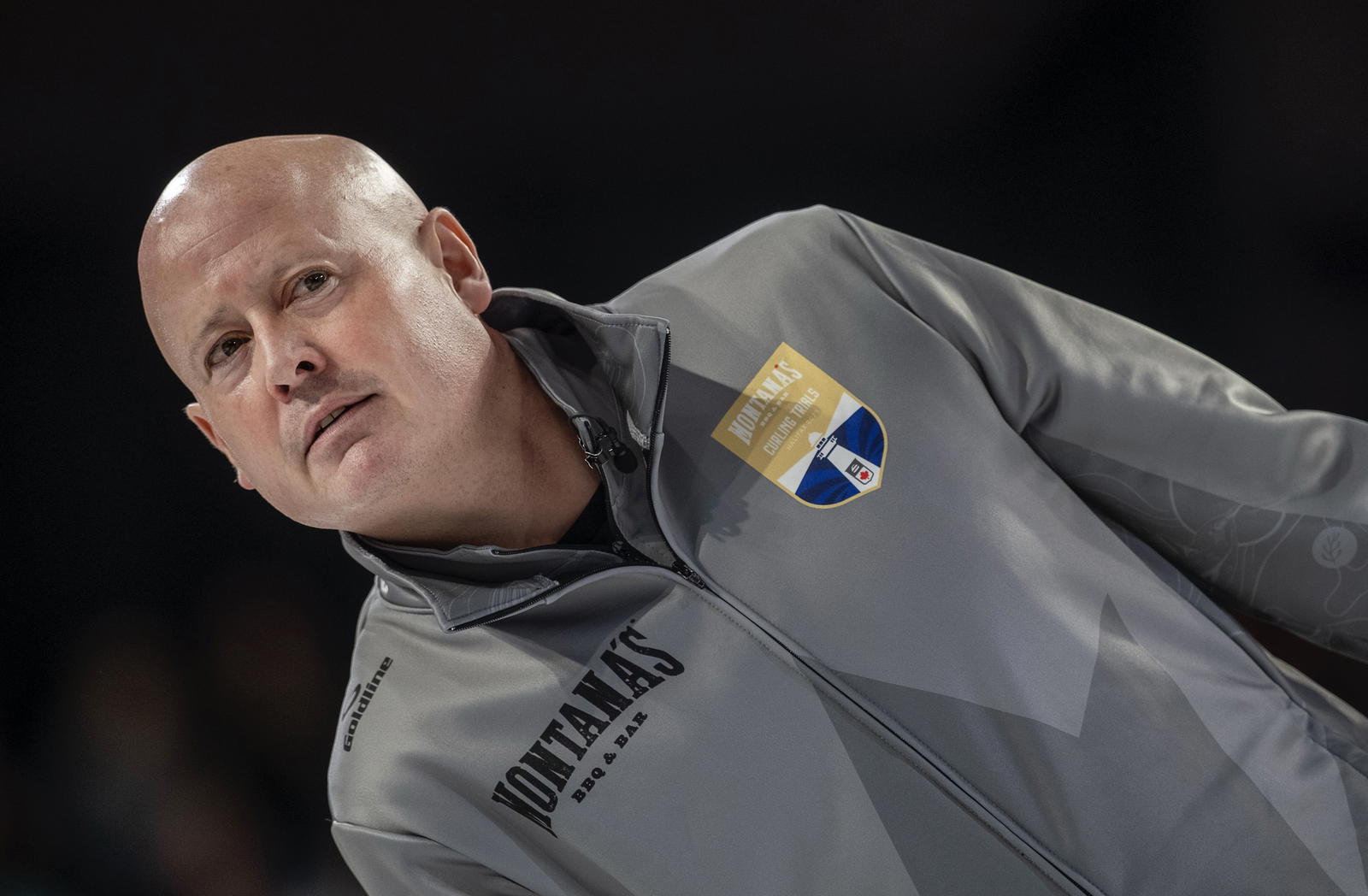 Kevin Koe • Andrew Klaver-Curling Canada
*****
The Trials are ideal for live in-person viewing. The television broadcast can’t capture the many twists and turns occurring in four simultaneous competitive games. Heads swivel from shot to shot, barely able to keep up with all the drama unfolding.
*****
The applause is uneven at times as fans are viewing different sheets and cheering is limited to those who saw what happened, while others are fixated on the shots from another game.
The cowbell women of Collingwood tried to help, rattling their noise making devices not for their favourite teams (which they would not reveal) but for what they deemed to be “great shots”. It was surprising to hear them silenced on great shots I considered to be pistols, and my request to borrow their bells for these moments was met with stern glares and a disparaging “no.”
*****
Girl 1 from the 2 Girls and a Game podcast advised me Nova Scotians take rules seriously after I shared two encounters. In the first, I stood by a railing mid-sheet to assess the games before deciding where to sit. An usher asked me to leave as it was determined I was a “fire hazard.” Acknowledging I had gained weight, I assured her I could move quickly if needed. Failing to convince her, I moved to a nearby seat.
The second incident involved the arena elevator operator, who spotted my Tim Hortons coffee cup. He handed me a generic cup sleeve from a pile in his possession and warned me that the logo was not to be visible in the arena. I suggested the logo would be hard to see from the sky-high press box, but he insisted I comply.
Just like Last Stone Draws to the button to determine tiebreaker games, rules are rules.
 Saturday frost warning • Kevin Palmer-The Curling News