


Nov 9, 2025 7:01 PM
Updated Nov 9, 2025 7:10 PM
New curling roles, rules and recent success for columnist Mike Fournier
One of the curling projects I have gotten into over the past few seasons has been coaching.
Last season, I coached a women’s team at the Ontario Scotties, and this year I find myself on the coaching staff of the University of Toronto “Varsity Blues” curling teams.
Coaching is fun. I get to share my Yoda-like wisdom with a new generation of curlers. “There is no try, only draw!” More importantly, it allows me to share my passion with more people, whether they like it or not.
 U of T men at nationals in 2014 • Curling Canada
One thing that has troubled me is some rule changes that have come into play around university and junior curling.
Back when I was a junior – a million years ago – our coach was a volunteer from the club that sat and drank a scotch behind the glass and drove us to spiels (sometimes in that order).
Today coaching is much more prescriptive, and coaches are expected to do much more after the game to help players understand what they did right or wrong. This is where I feel I add the most value, in helping teams get into the right mindset and think around their next event or their season.
The on-ice, in-game discussions are limited. There is only so much you can do. You get one time out, to go out and discuss a key situation. And you can influence between ends and at the fifth-end breaks.
But here is a twist from last year. In University league, and in junior play, coaches are expected to be out on the ice with their teams, for the entire game. I guess the intention is to be able to provide coaches with on-ice access, and simulate the settings in arenas where the coaches are positioned directly behind the sheets.
There are many opinions on this change. The 2 Girls had some differing thoughts in their latest episode – that segment can be viewed/listened to here.
Here’s my opinion… what kind of helicopter-parenting thinking is responsible for the idea that at a curling club, a coach should be out on the ice? This is a horrible idea. I think it is a conspiracy driven by the battery-heated-jacket people to sell more warming jackets.
 Curling clubs can FEEL LIKE THIS • Rick Wood-Imagn Images
First of all, curling clubs are cold. Coaches sitting on the ice for two-plus hours in the cold sounds like the worst idea ever. It’s already bad enough in an arena, but in a club facility, this would be a nightmare. I caught a cold just thinking of this.
Second of all, it removes the independent learning from the game. Curling teaches kids. It teaches problem-solving, it teaches strategic thinking, it teaches teamwork with a goal to accomplish something. There is nothing worse than a hovering coach to kill independent thought.
Let. Them. Play.
And let the coach sit it the warmth of the club. Otherwise we will have an even harder time finding volunteers to help out.
Speaking of Rule Changes
A couple of recent rule changes and proposed rule changes have the curling world talking of late.
First, there was a rule in play at a recent Grand Slam event to limit the number of blank ends to one per game. I think this will make very little difference in making the game more interesting.
It will change the strategy in subtle ways – especially in ends 6 and 7 if you know the team you are playing against has already used their blank – but the sad fact is the best teams in the world will still find a way to be as boring as possible when they are in the lead.
The problem is not that they are blanking ends, the problem is that once a team has the control point, they have an incentive to make the game as boring and wide open as possible. This will not really change with the limited blank end rule.
I think as we contemplate rule changes for the elite, the most effective rules will result in making the game harder – in other words, the players will execute fewer perfect shots. Maybe we should eliminate stopwatches, force players to rely on judgement (spoiler: the best already do). Maybe we should make the rocks “deader” so it’s harder to make double peels.
 If they listen to Hackner, they’ll listen to Fournier, right? • USA Curling
The other rule sparking discussion is the proposal at the World Curling level to require teams to change the sleeve on their brush heads for every game.
For my non-curling readers, the heads of brooms have driven so much controversy over the past decade, it would take me way too many pages to give you the history. But in quick summary: in competition, teams are required to use brush heads with a standard fabric. The fabric is mustard yellow, and is a less effective sweeping device than the standard broom that recreational curlers use at the club.
It would basically be the equivalent of forcing Rory McIlroy to play golf with a crappy golf ball that only goes 75% as far (which is also happening in the next few years).
I am assuming this rule is in place because some teams have discovered that using old, beat-up heads might be as effective or even more effective than a new head at scratching the ice and influencing the path of the rocks. Forcing them to use a new head every game standardizes things, in a way, for every team.
Pads have become a big issue, especially since the purchase of Hardline by Goldline. A new competitive yellow sleeve costs over 27 bucks with tax.
Equipment companies typically sponsor big teams by giving them either free or discounted broom heads, but for the average club curler getting into competition, this is the equivalent of forcing a Sunday golfer to use a new $6 Pro-V golf ball on every hole. It’s not an issue for the pros, but it will get expensive for the average Joe who plays in competitive rec events like the club championships or the provincial and national mixed (and it already is).
I am interested to understand the reasoning behind the rule change: is there actual data that suggests older pads might work better? If yes, let me know – I have a bag full of old pads lying around for sale. Cheap.
 Three-legged champs in Stroud
Update on Team Fournier
A quick update on my team. After a disastrously slow 1-6 start to the season, we seem to have something going. We qualified for the quarterfinals at the Stu Sells Toronto Tankard, and pulled of a tournament win a few weeks ago in Stroud.
We did not qualify at the Henderson Fall Metal Classic in the Soo, but played pretty well anyway. We are actually back above .500, and have some momentum going!
And I have even pulled out some old-school, JM Ménard-inspired line calling – going full spread eagle on the ice. Fortunately, I have not reached the “I’ve fallen and I can’t get up” phase of my curling career. Yet.
As I write this I am finishing up a practice weekend with the boys in Forest, Ont.
Practice – we talkin’ ‘bout practice?
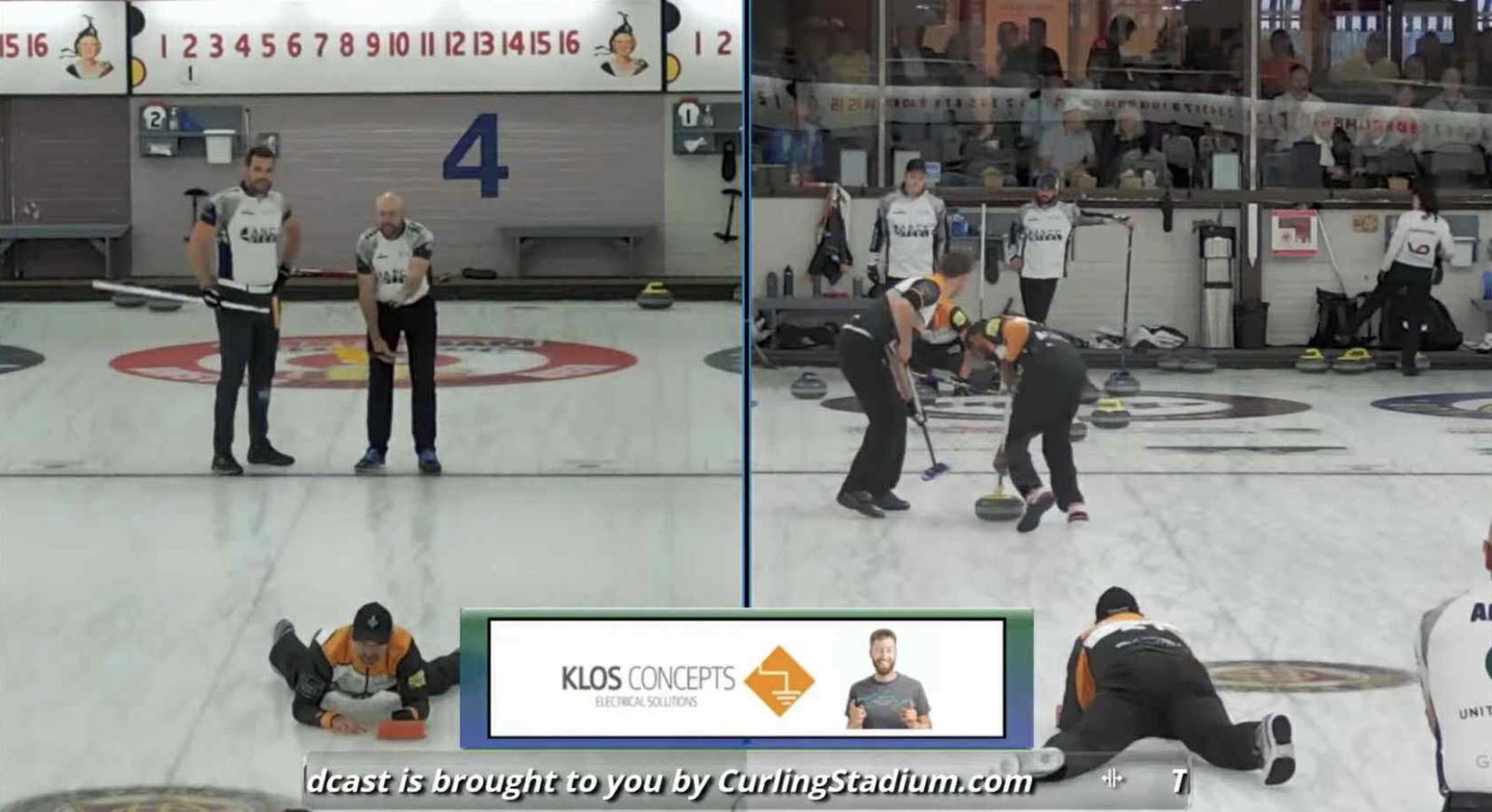 The flop, live on YouTube
1
Comments

Powered by RoundtableBuilt on infrastructure designed for real-time media. Learn more at RTB.io.© Roundtable 2026. By using this site you agree to the Terms of Use and Privacy Policy