



With the Olympic curling season well underway, I’m happy to share the news that I will be part of the host broadcaster curling commentary team at the Milano-Cortina Winter Olympics.
This will be my fifth Olympics as a host broadcast commentator (three Winter, two Summer). The host broadcaster produces English language commentary that goes to every rights-holding Olympic broadcaster worldwide. That’s why it is sometimes called “the World feed”– it literally goes everywhere.
Rights-holders like CBC, NBC and BBC will often use their own commentators, but usually only put them on games involving their own teams. They also get access to all the other games, so they will often take the World Feed commentary for those games and make them available on their digital platforms. So if you are watching Olympic curling games wherever you are, and you’re wondering “Who’s that doing the commentary?” chances are it’s me or one of my World Feed colleagues.
A lot of people ask me about commentary “behind the scenes” stuff. I’m happy to share some of that with you here.
Doing commentary at a curling competition is a little bit like how I used to approach it as a competitor.
First you look at the field. There are a bunch of competitors – who looks the strongest? Who could surprise? Who has an interesting backstory?
Then you look at the competition format. It’s like telling a story – there’s a beginning (pool phase), a middle (playoffs) and an end (medal games). All the contests along the way are part of the story, but there can be only one Olympic champion. What does the story arc look like?
You’d probably be surprised by the amount of preparation work that commentators do before a show. There are a few areas that we always focus on and think about.
Pronouncing athlete names properly is a huge one. You might think this is easy, but I can assure you it is not, especially when you are broadcasting to the entire world as we do on a host broadcast feed.
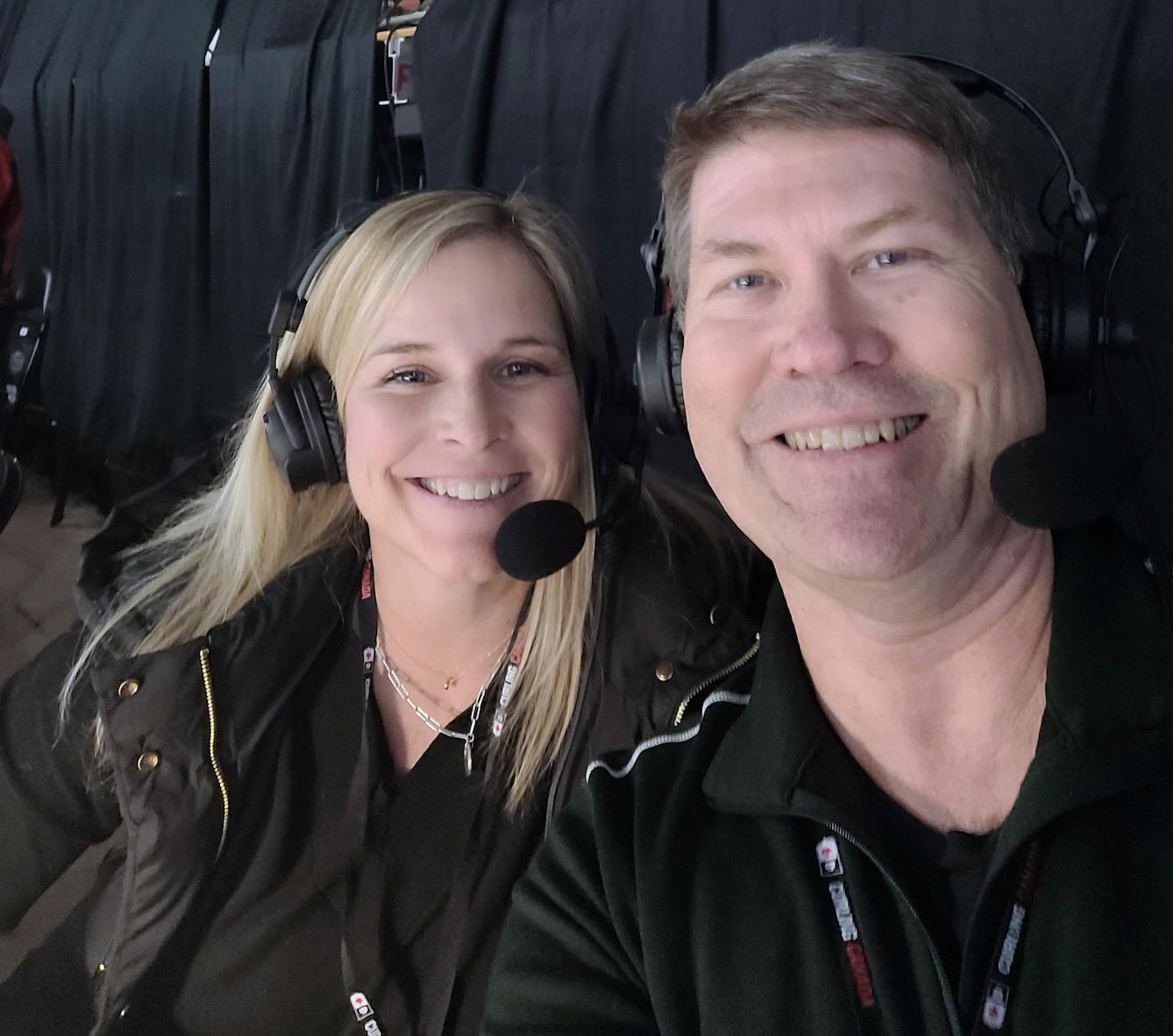 The author – with new book author Jennifer Jones
My rule of thumb is to always try to find audio of the athlete saying their own name. If I can find that, that’s what I go with. This can take a lot of time. I was really happy that at the Paris Olympics, the IOC included – for the first time ever – clips of the athletes saying their names as part of their athlete biographies.
North American ears get used to hearing “anglicised” pronunciations of Asian and Scandinavian names, which often bear no resemblance at all to how the athlete says his or her name. We don’t always get it right, but we always try our very best to get it right. Other than “the commentators talk too much” mispronouncing names is always the at the top of the viewer’s commentary complaint list.
Another area of preparation is historical performance. Have these teams played head to head? What kind of season have they had? What kind of overall career success have they had?
Finally, and for me the most interesting research, are bits and pieces of insight and interesting information about the athletes themselves. Do they have an interesting hobby? Have they done something amazing just to be here? Have they said something interesting in an interview that could be relevant to the game they are about to play?
You wind up with an enormous amount of background information. The key thing for me is to have the discipline not to try and wedge all of it into a broadcast. If there is a moment, and a background fact enhances that moment, perfect – that’s why you do the homework. But if there is no obvious place to use a fact or the fact doesn’t make the story better, then don’t use it.
The next thing to consider is – who is the audience? The worldwide viewing audience for Olympic curling is completely different than the audience for a world curling championship.
When I’m working on a world championship event (the last one I did for World Curling was the World Women’s Curling Championship 2025 in Uijeongbu, Korea) I know that the entire viewing audience are knowledgeable curling fans. That means I need to spend very little time explaining the basics of the sport, and I can safely dive deep into technical and strategy discussions without too much explanation.
At an Olympics, it is very, very different. Ninety percent of the viewing audience is either watching curling for the first time, or only watches it every four years during Olympic broadcasts.
That means for Olympics I need to spend more time explaining the basics of the sport, and more time explaining some of the basic technical things (like how the athlete slides, why do they turn the handle etc.). For very knowledgeable fans, this can seem a bit frustrating – but they represent a tiny fraction of the worldwide viewing audience. I’m always making it my mission to turn that 90 percent of the audience from casual Olympic curling grazers into lifelong curling fans.
My favourite Olympic curling viewer feedback is “I started to watch it, I didn’t really know why, but then I got hooked and now I’m watching it all the time.”
Check out my next column for another question I often receive, a reveal about Milano-Cortina and another of my “secret weapons” as a curling commentator.